An LLM is an amplifier
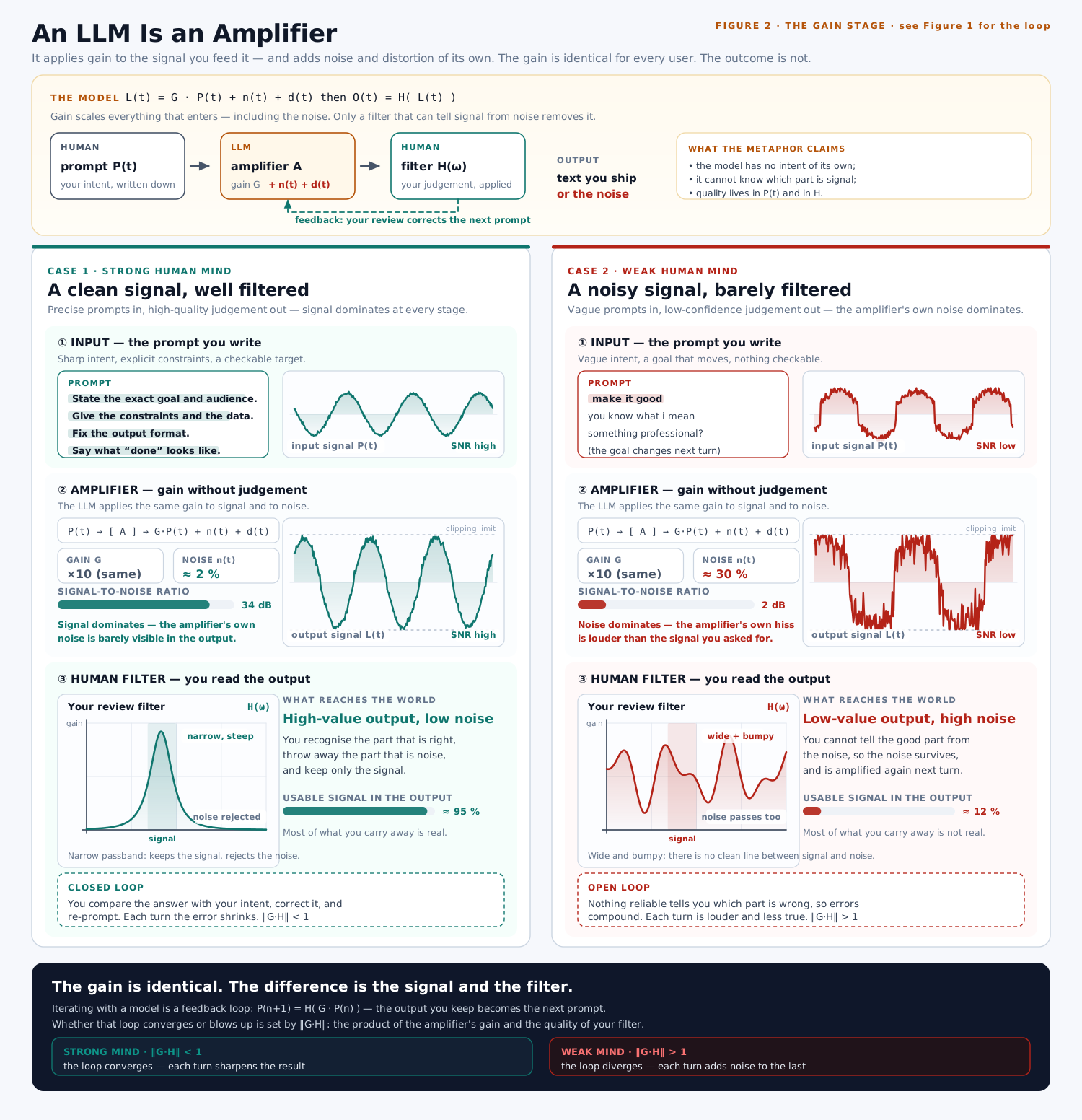
Step 4 of the loop is where the model turns your input into an output. The most useful way I have found to think about it is electronic: the model is an amplifier.
An amplifier does not invent a signal. It applies gain to whatever enters, and it adds its own noise and distortion along the way. So the thing you asked for comes back larger, and so does everything else that was in the input, including the parts you did not mean.
How to read the figure
- The amplifier is the LLM.
It applies a large gain
Gto everything it receives, and it injects its own noisen(t)and distortiond(t). Same weights, same gain, for everybody. - The input signal is your prompt. A strong mind writes a clean, high-SNR signal: sharp intent, explicit constraints, a checkable target. A weak mind writes a weak, noisy one: vague intent, a goal that moves.
- The filter is you, reading the answer. This is the part people forget. The filter's quality, its Q, decides how much of the amplifier's noise survives into what you actually use.
Two users, one amplifier
| Stage | Strong human mind | Weak human mind |
|---|---|---|
Input P(t) — the prompt |
clean, high-SNR signal | weak, noisy, distorted signal |
Gain G — the LLM |
applies G to signal and noise, adds n(t) + d(t) |
identical gain — the same ×10 |
Filter H(ω) — your review |
narrow, high-Q: signal in, noise out | wide and bumpy: noise passes too |
| Result | high-value output, noise ≈ 2 % | low-value output, noise ≈ 30 % |
The gain is identical in both columns. Everything that differs comes from the quality of the input signal and the quality of the human filter.
Why the weak case is worse than "less good"
Because it is a feedback loop.
Write the turn as P(n+1) = H(G·P(n)): what you keep becomes the next prompt.
If ‖G·H‖ < 1 the loop converges and every turn sharpens the result.
If ‖G·H‖ > 1 the loop diverges: the noise you failed to filter is re-amplified, and the output drifts further from anything true with each turn.
The weak case is not a smaller version of the strong case; it has the opposite sign of behaviour.
- Strong mind, closed loop. Clean prompt, so the model's gain works on mostly signal; you recognise the errors and discard them, so the next prompt is cleaner still. The model behaves like a force multiplier.
- Weak mind, open loop. Noisy prompt, so the same gain is applied to the noise; you cannot tell the errors from the signal, so they survive, and the next prompt is noisier still. The model behaves like a noise multiplier.
What the metaphor says to actually do
There are only two knobs: raise the signal-to-noise ratio of the input, and raise the Q of your own review. Nothing else is under your control.
- Raise the input SNR. State the goal, the audience, the constraints, the data, the output format and what "done" looks like, before you ask. Each of those removes a degree of freedom the amplifier would otherwise fill with its own noise. A prompt you cannot make checkable is a prompt you cannot filter.
- Raise the filter Q. Ask what would have to be true for the answer to be wrong, and go check that thing. If you have no way to check it, the honest reading is that you cannot tell signal from noise yet, so treat the output as unverified rather than as knowledge.
Corollary: the same model is a force multiplier inside your own field and a noise multiplier outside it. Knowing which one you are in is most of the skill.
Where the metaphor breaks down
- An amplifier is linear; LLMs are not. Gain is not constant: it varies with the prompt, the context and the task.
- The model does add genuine information, recombining what it learned in training. A true amplifier only scales what enters. This is better described as an amplifier with a large stored bias supply.
- Noise is not random here. Model error is structured: plausible, fluent and consistent, which is exactly why a weak filter cannot remove it.
- "Weak mind" is not a fixed property of a person. It is a property of a person in a domain: anyone is a weak mind outside their field and a strong mind inside it.
This is the mechanism underneath step 4 of the loop. The map is in the previous post.